
2027 GMC Sierra 1500’s New V8s: 402 hp, 481 hp and the Changes That Matter
Manitoba truck shoppers will see two numbers repeated about the 2027 GMC Sierra 1500: 402 hp and 481 hp. They belong to two different engines, and no single Sierra makes both. Knowing which V8 sits in which truck is the first step to choosing well. The bigger number is not always the better fit for […]
Manitoba truck shoppers will see two numbers repeated about the 2027 GMC Sierra 1500: 402 hp and 481 hp. They belong to two different engines, and no single Sierra makes both. Knowing which V8 sits in which truck is the first step to choosing well.
The bigger number is not always the better fit for the work you do. Here is what each V8 changes for towing, hauling and everyday driving.
Two New V8s, Two Different Jobs
The 2027 Sierra 1500 adds two all-new sixth-generation Small Block V8s, both naturally aspirated. The 5.7 L V8 makes 402 hp and 428 lb-ft of torque. The 6.6 L V8 makes 481 hp and 501 lb-ft, which makes it GMC’s most powerful half-ton V8 ever and the largest-displacement V8 in its class.
Both V8s share a 10-speed automatic transmission with the rest of the lineup. They sit beside an enhanced 2.7 L TurboMax four-cylinder (350 hp, 455 lb-ft) and the Duramax 3.0 L Turbo-Diesel six-cylinder (305 hp, 495 lb-ft). That is four engine choices, so the V8 is a decision, not a default.
What Changed Under the Hood
Both V8s run higher compression ratios, larger throttle bodies and tuned intake manifolds. Each also pairs direct injection with port injection. In plain terms, the engine can metre fuel more precisely across a wide range of loads, from light cruising to a heavy pull up a grade.
The two V8s differ most in size. The 6.6 L adds displacement for more peak power and torque, while the 5.7 L trades some of that output for the highest tow and payload ratings in the V8 pair.
| Maximum rating | 5.7 L V8 | 6.6 L V8 |
| Output | 402 hp, 428 lb-ft | 481 hp, 501 lb-ft |
| Max towing | 13,500 lbs (6,123 kg) | 9,400 lbs (4,264 kg) |
| Max payload | 2,140 lbs (971 kg) | 1,450 lbs (658 kg) |
| Standard on | AT4, Denali | Denali Ultimate |
What the Numbers Mean Behind a Trailer
The table holds the surprise. The 6.6 L is the power leader, but the 5.7 L carries the 13,500 lbs (6,123 kg) towing rating. That figure belongs to a Double Cab 4WD with the Max Trailering Package. A Crew Cab 4WD with the same package is rated at 13,300 lbs (6,033 kg).
Spec the 5.7 L without the package and the number drops. A Regular Cab 2WD is rated at 9,700 lbs (4,400 kg), and a Regular Cab 4WD at 9,400 lbs (4,264 kg). Cab, drive system and packages all move the rating, so the truck you plan to tow with sets the number, not the engine badge alone.
The 6.6 L is rated at 9,400 lbs (4,264 kg) in the Crew Cab, with a 1,450 lbs (658 kg) maximum payload. That trade makes sense for a flagship built around refinement and effortless acceleration. It would be a poor match for a buyer whose priority is the biggest trailer or the heaviest bed load.
For context, the Duramax diesel reaches 12,100 lbs (5,488 kg) in a Crew Cab 4WD with the Max Trailering Package. The 5.7 L V8 still tops it by 1,400 lbs (635 kg) in its best configuration.
Driving Character: Revs Versus Low-End Pull
The two V8s peak differently. The 6.6 L makes its 481 hp at 5,800 rpm and its 501 lb-ft at 4,000 rpm. The 5.7 L makes 402 hp at 5,500 rpm and 428 lb-ft at 4,300 rpm. Both are naturally aspirated, so power builds with the revs, with no turbo to spool.
Both V8s use a 3.23 axle ratio, the same as the diesel. The 10-speed automatic has ten gears to keep the engine in its working range.
Which Trim Puts Which V8 in Your Driveway
Trim decides the engine more than most buyers expect. Standard engines run as follows:
- Pro and Elevation: the enhanced TurboMax is standard, and the 5.7 L V8 is an option on both.
- AT4 and Denali: the 5.7 L is standard. Denali also offers the 6.6 L as an option.
- Denali Ultimate: the 6.6 L is standard.
- AT4X: the Duramax diesel is standard, with the 6.6 L optional.
The Elevation also lists the Max Trailering Package as an option. That is the route to the top tow ratings on a trim with a work-ready bed, which includes 16 standard tie-downs and the MultiPro Tailgate.
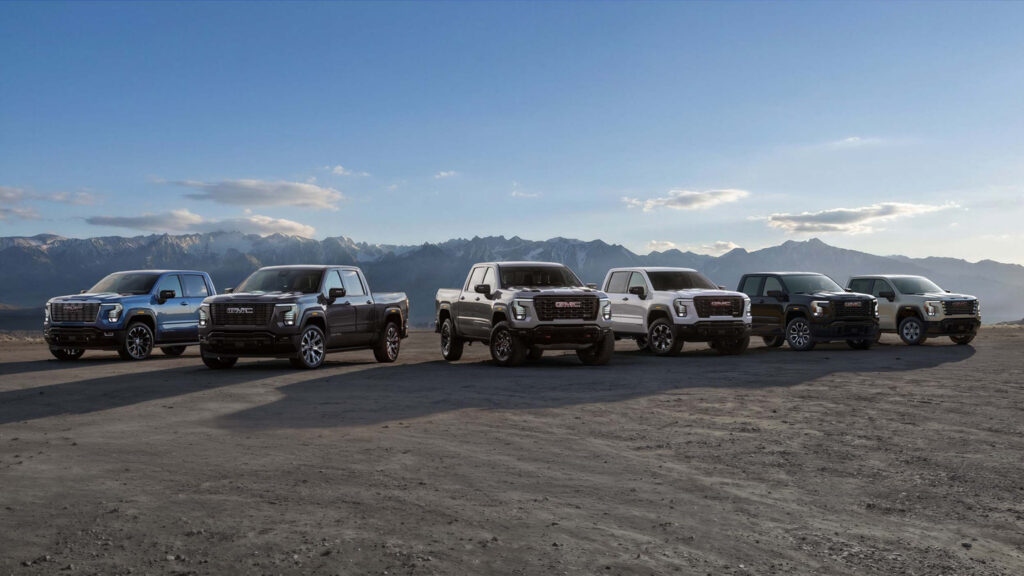
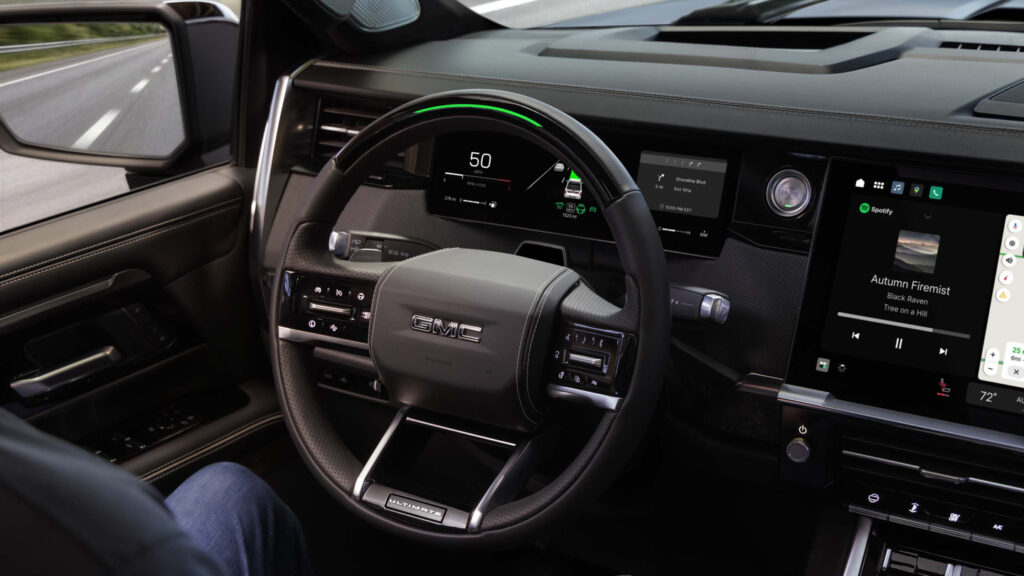
The AT4 pairs its 5.7 L with a 2-inch factory-installed lift, monotube shocks and 34-inch all-terrain tires. Denali adds Adaptive Ride Control and Denali Premium Suspension. Denali Ultimate stacks the 6.6 L with 14-way heated, ventilated and massaging front seats and a 15-inch Head-Up Display. Super Cruise with trailering capability is standard on AT4, AT4X, Denali and Denali Ultimate.
A Redesigned Truck Around the New Engines
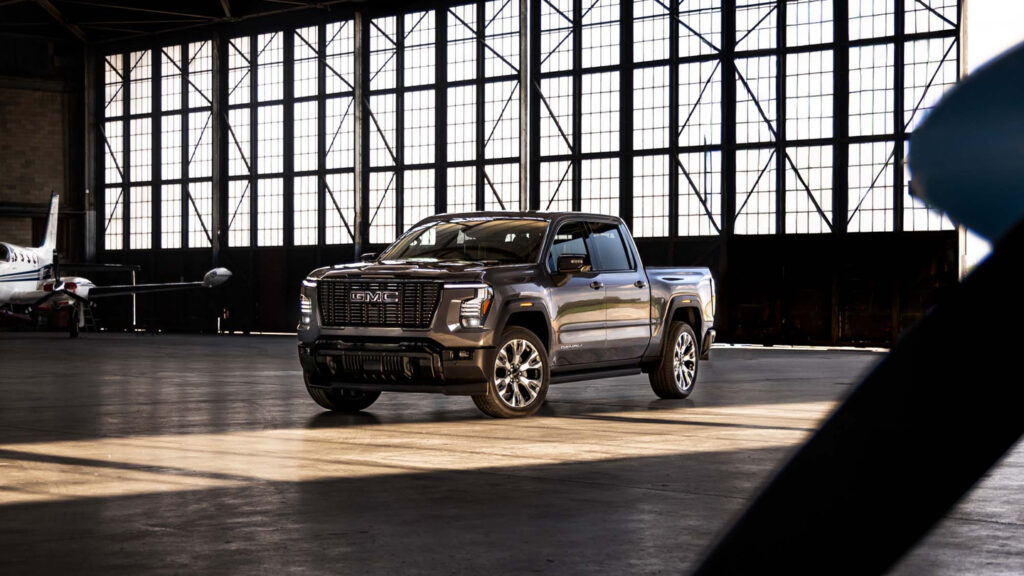
The V8s arrive with a more upright exterior, a more vertical grille and 7-shaped headlamps. Inside is a new cabin with a 16.3-inch infotainment screen and a 12.2-inch Driver Information Centre. The new MultiPro centre console adds storage and a work surface. The V8s are the headline, but the truck around them is new too.
Who Should Choose Which V8
Choose the 5.7 L V8 if you tow a large trailer or haul heavy loads. It offers the higher tow and payload ratings, and it is the engine in the AT4 and Denali. It is also a Pro or Elevation option, so a work-focused build can have it too.
Choose the 6.6 L V8 if you want the strongest naturally aspirated Sierra on the road and plan to use it as a premium daily driver. Its home is Denali Ultimate, with a Denali option for buyers who want it one step below the flagship.
If you tow well under 9,400 lbs (4,264 kg), the extra output of the 6.6 L costs you nothing in capability. If your trailer is heavier than that, the 5.7 L is the V8 to build around.
Choosing Your 2027 Sierra 1500 V8
The 2027 Sierra 1500 gives V8 buyers two clear paths: the 5.7 L for maximum trailering and payload, and the 6.6 L for peak output in the flagship trim. Cab, drivetrain, bed and package choices decide the final ratings on either truck.
Visit McNaught Buick GMC in Winnipeg to walk through the V8 and trim choices with the team and find the Sierra 1500 that matches the load you tow.